

PhD student at University of Grenoble Alpes (France)
Well logging and physicall properties
Interviewed by Beatriz Martinez-Rius
Interview date: September 14, 2024
Location: D/V Chikyu (IODP Expedition 405)
Disclaimer
This transcript is based on a video-recorded interview deposited at MarE3, JAMSTEC (Yokosuka, Japan).
The transcripts of the research project Oral Histories of Scientific Ocean Drilling are polished representations of oral conversations, and are intended solely for the purpose of preserving and documenting personal accounts and memories. They are not a literary product, and are not intended to exhibit literary qualities.
The primary goal of this transcript is to capture the spoken words and memories of the interviewee as accurately as possible. Minor editing and polishing works have been performed to enhance clarity and readability while maintaining the authenticity of spoken discourse, including non-standard grammar, inconsistencies, repetitions, and pauses. The interviewee has been allowed to review and edit the transcript, and they have approved the publication of this version before posting it.
The reader must be aware that memories of an event can vary between individuals and may evolve over time due to various factors, such as subsequent experiences, interactions with others, and personal emotions.
Use and citation
This transcript is the property of JAMSTEC and is subject to its regulations. Quoting, reproducing, or distributing this transcript, in its entirety or in part, for non-commercial uses is allowed with due attribution.
Please cite the interview as:
Interview of Pei Pei by Beatriz Martinez-Rius on 2024 September 14, D/V Chikyu (Japan). [link]
Beatriz Martinez-Rius (BMR): Today is September 14 of 2024. I am Beatriz Martinez-Rius, postdoctoral researcher at JAMSTEC. I am on board Chikyu, Expedition 405, with Pei Pei. Thank you.
Pei Pei (PP): Thank you.
BMR: So please, can you tell me your name, your affiliation, and position?
PP: My name is Pei Pei and I’m from France. I’m studying at the University of Grenoble Alpes, and my position is a Ph.D. student. My nationality is Chinese.
BMR: Are you learning French?
PP: Yeah, a little bit. Just to say, “Hi, nice to meet you” …… something like that.
BMR: I know French is very challenging for people who don’t have a background in a European (Latin) language.
PP: Yeah. Because I couldn’t speak English very well in my first year, I spent a lot of time practising my English. And then I started to learn some French, but it’s not very good (laughs).
BMR: Yeah, French is difficult. In these sorts of communities (IODP) English is not the first language for most of us, so we do our best (laughs). That’s something nice, that we all speak the same language but come from different places, so we keep as a background our accent.
PP: Yes, thank you, I was a bit stressed about recording this as a video. Because if I speak English, I will think of something that I don’t remember something…English is not my first language.
BMR: Do you learn English in China?
PP: Yeah, yeah. I started to learn English when I was in primary school, but we only use English for the exams. In China we have to learn a lot of different subjects, and also we don’t have a very international environment. So we don’t have the opportunity to communicate with each other in English. That’s why when I came to France, I needed to improve my English first.
BMR: I think it’s similar in other countries, in Spain for example. We learn grammar and vocabulary, but we don’t really speak at school.
PP: Yes. That’s why I can understand easily when I listen to English, but I can’t speak very fluently.

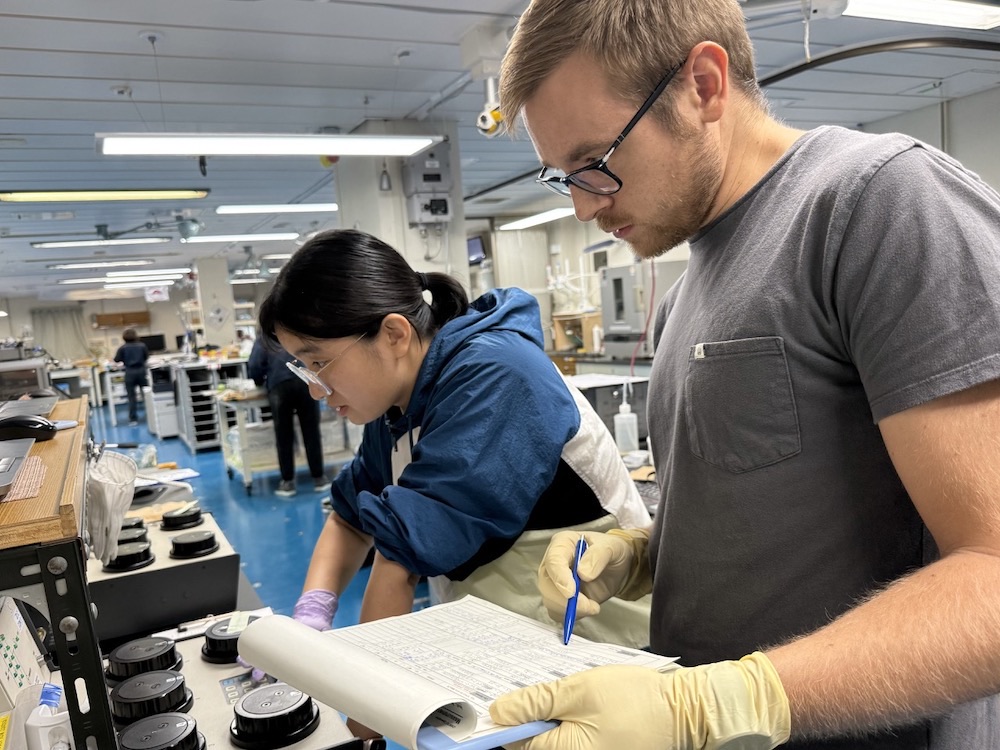
Left, discussion over cores during IODP Expedition 405, ©️Doriane Letexier / JAMSTEC / IODP. Right, Pei Pei and Jonny Ford doing experiments on the core samples, credit: JAMSTEC/IODP.
BMR: So please, tell me where you come from in China, and what is your background.
PP: I’m from the east part of China, and my university is in Qingdao. Yeah, I did the Bachelor’s and Master’s in there for about seven years. And my background is in geological engineering. I studied in the engineering school, related to the oil and gas industry. So, I learned borehole geophysics for seven years. And then, I wanted to learn more about scientific drilling more than commercial drilling. So, I wanted to learn more about the science that they did. That’s why I came to France, to join the ISTerre (laboratory Institute Science de la Terre).
BMR: Why did you choose geological engineering? What did you like about that field?
PP: Because my hometown is highly related to the petroleum industry. Our city it’s like located in basing, so it’s full of oil and gas. So we have more opportunities to communicate with petroleum companies. That’s why I chose petroleum (engineering). And my parents, they had worked for oil and gas companies thirty years ago. I wanted to continue to do that. But when I learned, I thought that – how can I say this – it was more boring. So, I wanted to say, “Maybe I have another opportunity to explore more scientific things”. That’s why I changed to this (laughs).
BMR: So your parents were also geology engineers?
PP: No, they were technician.
BMR: On land or offshore?
PP: On land. But they didn’t work there for a long time, just maybe three or four years, and then they changed their job. Because they spent a lot of time in the basin, and it’s far away from our home.
BMR: It was like very demanding, to be there.
PP: Yes!
BMR: So your parents were kind of an influence for choosing that career, and then you decided that maybe the industry was not your thing, but that you wanted to try more the science-side.
PP: Yes! When I did my master study, I had the opportunity to join some commercial drilling projects. Most of them didn’t interest me, and I want to do some research on more challenges.
BMR: Why France? Why did you decided to go to France?
PP: (Laughs) That’s very interesting. I couldn’t choose the American because of some politics, and I wanted to or preferred to choose a more open environment. That’s why I chose Europe. And then, I tried to find more opportunities. France was the first response I got (laughs), so I chose France.
BMR: Well, it’s great! It’s a position at Grenoble, I think it’s very beautiful and quite different probably from where you grew up in China.
PP: Yeah, it’s very beautiful.
BMR: What was a cultural shock for you, when you arrived in France?
PP: People are very friendly to me… But a very big challenge is that I can’t speak French. It’s very difficult for me to live there because when I went to a supermarket, they all spoke French (laughs). Hardly some people can speak English, but not very fluently. That’s been a cultural shock for me, but people are very, very nice, and they are very patient. So, if I have some problems I can ask, and they will help me to solve them.
BMR: Yeah, that’s nice. So how did you learn about scientific ocean drilling, about IODP?
PP: I learned about IODP when I did the master study because, you know, China will do an IODP project. So, I learned about it because my master supervisor have some projects related to gas hydrate. And then, we had some program to do… But unfortunately, I can’t join this, because I’m a female. In China, we don’t have more space for females. It’s not like in Europe, that they will do the balance. In China, most of the work is for the men. So I couldn’t do this, but I really want to because I know that the work is focused on science, not on commercial things. Then I tried to find a PhD position – if somebody was related to the IODP, I could ask her or him how to have a position like that. So, I’m very lucky that I can join this project.

BMR: That’s actually great. So if I understood, in China only the – let’s say – those at the top can go into the drillship or into scientific ocean drilling, so there’s a lot of competition, and there are already many senior scientist that will go onboard, so it’s more difficult for young career scientists to go in.
PP: Yes, it’s more difficult for young, starting career scientists, and also it’s difficult for women because in China we need to separate the accommodation, so we don’t have too much space for women. That’s why not all of the women can go offshore. I also tried to find a job at Schlumberger China, but they told me, “Schlumberger China only gives a few positions for the women that can go offshore. But our national company can’t do this”.
BMR: So you came to this expedition through ECORD, the European consortium.
PP: Yes Yes, I’m very surprised I could have this opportunity to go offshore drilling.
BMR: Why did you apply for J-Track? What attracted you to this expedition?
PP: Because when I started my PhD, my supervisor told me that I had an opportunity, maybe could go offshore to do the drilling. And so I asked her, “Do I have some opportunity to do some study about the previous J-FAST?”, and then she told me, “Yes, you can do that”. I started to learn about the Japan trench background and then – because, you know, it was a very, very large earthquake. It’s not very normal. So, I think it’s a very good opportunity to know what happened here. Then, I started to learn about this, and I wrote an application, and I got a positive response. (laughs)
BMR: Have you been offshore before?
PP: No, no. It’s my first time.
BMR: What is your first impression?
PP: I can see the seaside, it’s very beautiful. It’s my first time to go onboard, and I can see the sea here, around us and… I think all of these things are very impressive for me.
BMR: How about the team? The relationship with scientists?
PP: Oh, yeah, they are very good. And actually, it’s my first time doing a presentation like this. I think all of the people are very friendly and they are very focused on their work, and it made me continue my research. And then I can learn a lot from the drilling team, or the logging team. I can know a lot of things that I have never heard about. A very important thing is that I can get firsthand data because, you know, I got some data from the website. But I could only get simple values or a table. But here, if I find the value is wrong or something, I can ask the support team to ask why it’s here, and what’s wrong with this value.
BMR: Actually, the community component is something that in general, everyone values very much.
PP: Yes! It’s very nice.
BMR: You can really learn from other people. So you come here to the expedition without necessarily knowing about the geological context or something.
PP: Yes, before I came on board, I had never touched something about geochemistry, or palaeomagnetism. But after coming here, people will teach me how to do this, and how to catch your idea. Yeah, I think it’s very good.
BMR: Yeah. So now the last question: where do you see yourself in ten years?
PP: Maybe, after ten years, I hope I can get a position in Europe because I like the open environment. If I can don’t that, maybe I will go back to China to join the IODP China. And I hope I can do something about that.
BMR: Nice. Thank you very much, Pei.
PP: Thank you.
