

Videographer and film director
Science Media NL
Interviewed by Beatriz Martinez-Rius and Lisa Smith (Curtin University)
Interview date: September 26, 2024
Location: D/V Chikyu (IODP Expedition 405)
Disclaimer
This transcript is based on a video-recorded interview deposited at MarE3, JAMSTEC (Yokosuka, Japan).
The transcripts of the research project Oral Histories of Scientific Ocean Drilling are polished representations of oral conversations, and are intended solely for the purpose of preserving and documenting personal accounts and memories. They are not a literary product, and are not intended to exhibit literary qualities.
The primary goal of this transcript is to capture the spoken words and memories of the interviewee as accurately as possible. Minor editing and polishing works have been performed to enhance clarity and readability while maintaining the authenticity of spoken discourse, including non-standard grammar, inconsistencies, repetitions, and pauses.
The reader must be aware that memories of an event can vary between individuals and may evolve over time due to various factors, such as subsequent experiences, interactions with others, and personal emotions.
Use and citation
This transcript is the property of JAMSTEC and is subject to its regulations. Quoting, reproducing, or distributing this transcript for non-commercial purposes is allowed with due attribution.
Please cite the interview as:
Interview of Dan Brinkhuis by Beatriz Martinez-Rius and Lisa Smith on 2024 September 26, D/V Chikyu, Japan. [link]
Beatriz Martinez-Rius (BMR): Let’s start. Today is September 26 of 2024. I’m Beatriz Martinez-Rius, historian of science at JAMSTEC. I’m onboard Chikyu in Expedition 405 with Dan Brinkhuis. Thank you very much. First, can you please introduce yourself? Name, job, position…
Dan Brinkhuis (DB): First of all, thank you very much Bea for inviting me to have this talk. My name is Dan Brinkhuis. I am a videographer, director, and I’ve been doing this for maybe 30 or 35 years. I started as a photographer but after my studies, I found video-film more interesting. You got a lot more dimensions to work with. So from that moment on, I became a director of a lot of commercial films, corporate films… Stuff like that. And then, in 2004, I got acquainted with IODP because my brother was part of the science party on ACEX Expedition (Arctic Coring Expedition), in 2004. That was amazing, because that was a Mission Specific Platform, where they went out to the Arctic and poke holes in icy conditions. So they had multiple icebreakers – that was like a fleet of ships. My brother was one of the scientists in there (note: Henk Brinkhuis). And obviously he told me the story and showed me a lot of footage, and I became interested, “Okay, this is actually very cool”, I thought.
Geology is, you know, fieldwork and hammer… So you got a kind of a limited view on geosciences, in general. Obviously, my brother got me engaged in that. So, that was my first interest. And then, in 2007, I contacted to – in that time there was, in Ocean Leadership, Leslie Peart. She was interested in new videos because the JOIDES [Resolution] had been refitted. After 15 years, the ship needs to be modernized for another 15 years. At that moment, all the outreach material that they had was kind of outdated, so they need a new stuff. And I was like, “Ding-dong, here I am, can I help, can I join?”.
For me, personally, my first expedition with the JOIDES Resolution was in 2010. IODP Expedition 118, with the JOIDES Resolution. I joined the science party in Wellington, New Zealand, and we spent two months back to back to the Antarctic. And from that point on, I basically fell in love in creating outreach on anything that has to do with ocean sciences. So, from then on, there were some more expeditions. I’ve been in IODP Expedition 342, in Newfoundland, right near the Titanic – that was pretty cool. We poke some holes. I was as a one-man band videographer, on that cruise. And then, from there on, I got really hooked into the IODP family. One thing led to another, and I was on Chikyu before I knew it. The rest is history. So, this is my fourth expedition on Chikyu, in a nutshell.

BMR: You are actually the legendary videographer on Chikyu. Everybody has told me about Dan.
DB: Well, it’s fun to see because I haven’t been on Chikyu for three years, partly due to Covid, which obviously had a major impacts on everything that we did – in IODP, obviously I’m a third party, I’m just the video guy. But, yeah… It feels like coming home, in the weird sense. And I have to admit it’s, you know, it’s flattering that when you come back, people are happy to see you. I think that at least we’re doing something good.
BMR: Yes, you are. So, let’s break out a bit the story we just talked about. Where are you from? And I’d also like to know why did you got into videography.
DB: I’m from Holland. I was growing up near the Utrecht region, which is much nicer than Amsterdam – if you go to Holland, go to Utrecht. Don’t go to Amsterdam. I studied at the Royal Academy of Fine Arts in The Hague. Photography. But then, I did an internship at a video production company and I immediately thought, “Oh, this is much more interesting”. So as soon as I got my diploma as a photographer, I bought my first video camera. And from there on, I like multiple dimensions and storytelling because that’s what it’s all about. You have a little bit more, you have moving images, you’ve got the music effect… So, there’s much more to play with, to tell stories. And that’s what drives me – basically, telling stories.
BMR: Before going into IODP, that first Mission Specific Platform expedition, you mentioned that you had been doing commercials and other kind of stuff. But never scientific outreach, right?
DB: No, not specifically. We were basically making commission films for all kinds of companies and brands, like Heineken and KLM. Basically, anyone who would like to hire us to make, mostly, marketing kind of films, which is obviously a very nice period because you travel a lot. These are big, international companies. So, for Heineken, I’ve been to Moscow. That was a long time ago. Traveling and storytelling, that became part of my rhythm. My wife is a flight attendant, so she also really enjoys flying. So we spent a lot of time abroad, doing the things we like.
BMR: Actually, you learned about IODP through your brother. And at that moment, you are thrown into a ship with scientists who sort of talk another language. So you come in with a set of skills, commercial videography, that is kind of different from the videos you will do onboard.
DB: Yeah.
BMR: So I’d like to ask you about your impressions, and the way you approached this new situation – making videos in such a unique environment.
DB: At the moment I joined the science party of Expedition 318, the JOIDES [Resolution] had been fitted with internet capability. So, we can actually do something from the ship. That has obviously had a huge impact on outreach. It became more interesting because normally, if you go out on the JR, for instance, before pre-internet, you make a film but you cannot edit it, you cannot do it… So you can basically only shoot on the ship, and then you edit the film later. But it will take normally a couple of weeks or months, and then, the story has already gone. But now, by actually being on the ship and reporting weekly, we made episodes every week. We actually build an audience on YouTube and over all the social media channels.
That was kind of the start of experimenting with short videos, not only science related but also to have kind of an atmosphere on how life is on board, because that makes it very special. That also helped me a lot, in having all these ideas and working with the scientists. To come up with short, nice videos that are, on the one hand, educational but on the other, also fun to watch. At that time that was new, because who was interested in a film that has been released six months after the expedition, right? That’s like a core being archived. So that was a big help. We actually, with Expedition 318 and previous – there was one expedition where a colleague of mine was hired. That was the PEAT Expedition (Pacific Equatorial Age Transect, IODP Expeditions 320 and 321). One of the scientists on board was their main character, he was like a presenter, and we called it PNN, for PEAT News Network. That was the first time that we experimented with basically this chopped up story, with these episodes and weekly updates. And interestingly, of course because you’re getting an audience via YouTube, you have questions and the next episode you can address them. So you are actually interactive. And that is a major boost to get the word out, because we were actually still sailing and trying to tell these stories from onboard.

BMR: When you go onboard, you find a scientific party which is a group of scientists that, although they might not know each other, they kind of work with the same stuff, for the same goals. But you come from outside, doing a very different thing. So how has been, in your experience, the relationship with scientists? How have you interacted with them, and also with the people that hires you to be onboard?
DB: Well, that’s a good question. If I – let’s say correlate, that’s a scientific term –, correlated to my previous work… If you make, let’s say, commercials, everything is timed because everything costs lots of money, and so everything is planned and you have a lot of stress. You only have 1 or 2 days for shooting… That’s a completely different process, once you’re on board.
Obviously, I talked to some experienced IODP staff, “How could I handle this?”. You know, I’m not going my first time to walk on the gangway having a camera in my hand. So he basically advised me, “Leave the camera in your cabin for a few days, just to get to know the ship, get to know life at sea, get to know each other”, as you mentioned. Because for most of the scientists there, this is also new for them. So, everyone is kind of excited but also kind of nervous, at the same time. It was actually a very good advice by Adam [Klaus?]. Not to put the camera right in, “What are we going to do? Why are we here?”, you know, these are the obvious questions. So I had to be like, “Okay, well, I kind of want to get my camera…”, but the big difference is basically that you are embedded. You’re becoming part of the science crew. And that takes a couple of days, sometimes even longer. And you get the feedback return – so, I’m not an outsider. I’m part of the team. And if that happens, you can do anything you want. Everyone is in.
One nice example is a crazy idea we had onboard, on Expedition 318 to the Antarctic. Sharon Cooper asked me, “Dan, if you are on the JR, and I know you are, could you do something like a short video, on… Basically turning ocean drilling for kids?” Which is obviously very challenging, because it’s a very complicated stuff. But then, in Holland I bought three… I just walked by the toy store, and there were these three hand puppets, penguins. And I said, “well, I got an idea. Let’s just throw them in my suitcase”. And I’m sure you have seen some… This was so much fun. Because the scientists actually they asked me, “When can we do the next episodes?”. So this was a nice way to engage the scientists, and become part of outreach. This is just one example of a maybe crazy idea. I realized that the first episode was not that good, to be honest, and also the shore people said, “Oh well…” but, you know, that’s the nice thing. I was not really tightly briefed. So we could work around it and make it even better. And I got more comfortable, the scientists got more comfortable, and it was a very nice way of telling stories. Not only about science, of course, but especially life onboard. When you were in the Antarctic and you have to go outside, everything is beautiful… Also for me, that was my first one, and I got this feeling that you’re really part of it. To be honest, when we reached Hobart after two months, everyone is kind of weird down. And you are looking forward to arrive to your hotel room, which is quiet, and have maybe a salad, and maybe a beer… But I, basically, I didn’t want to go home.

So, there was something magic going on, on the ship, that worked for me. Surely not every expedition is successful, or there are always some problems because – if I can make the metaphor by using Star Trek, it’s the same thing. We are a ship with a mission, with people that, as you said, don’t know each other, or maybe they just know from conferences, but not that close. When you are spending that much, so tight on each other…
So, what is the magic? The magic is for me is not really science, although I’m briefed to talk about the science; but it’s basically the interaction of the people on board the ship. That process, and I was part of that, is unique about the expeditions. It’s kind of what people say from it, you love it or you hate. There’s just not much in between. And obviously, I was on the on the other side, let’s say. So, I was fortunate to be part of Expedition 318.
The next expedition for me was two years later, Expedition 342 to Newfoundland. We basically put the same principle, with the new kind of look and feel, and even made it better, I think. But it was absolutely due to the to the collaboration with the scientists on board. If I would be like a news reporter, coming in for two days, and “Oh, this is the JOIDES, and look at this!”, you will not get the stories. Sure, the scientists will tell their story, but they basically run down their PowerPoint, which they know by heart because that’s their comfort zone. So, you have to be embedded, and then it works. If you adapt them, if you also take your time to get to know the people – because people changes, during this expedition, mostly in a positive way. But, let me emphasize that: it takes time. And, yeah, that’s what I called the magic. That is kind of like a family, in that sense, and you feel that when you are at the dock, when everybody’s going back home, back to their institutions. It’s weird, a weird feeling. You’re living so intensely together and sharing everything together and then, poof, everybody’s gone again. Hopefully you meet each other again on new expeditions, or in conferences, but it’s not the same atmosphere.
BMR: Yeah. The fact that the human relations that you have during two months, while on board, are only those with the people in the ship. This makes it really special, really unique experience. Based on what you just explained, there’s a couple of things I’d like to ask you. How scientists have reacted to your work?
DB: That’s interesting, because being basically thrown into this team, the first days you introduce yourself and I also make very clear, when I presented myself as a videographer, that if someone doesn’t like to be filmed or doesn’t want to be a part of it, that’s fine. So, you always have a group that kind of likes outreach and is more open, receptive to it. And there are just a few of them who say, “Okay, it’s important, but let me… you do your thing, and I will focus on my research”. During the first few weeks, you get to know these people and you kind of filter, you kind of sense it. Then I think, “Okay, this is someone with whom I can work with”. That’s also part of the process. And later on, the nice thing – just to give one example.
There was one scientist that said, “Well, Dan, I don’t want to be filmed”. Fine. If you’re walking by, I will cut it out. We were producing this weekly videos and these were pretty successful, because a lot of people actually watched them. A few weeks later, he knocked on my door and he says, “Dan, my family asked why I’m not in the films”. I said, “Well, that’s what you wanted”. To cut a long story short, I made a special item on his work. From that moment on, he was kind of in. So, it’s also kind of a task for educators to get those scientists in there, and help them. Because they are doing science, that’s their thing, and they want to communicate and tell their stories, but they’re not able to. So, if you get to know them, make them more comfortable, let them trust you, that you’re not going to make fun out of this or that… science’s first, basically; then you grow confidence and you bond, you build relationships on the on the ship. And then, basically, anything is possible.
BMR: So you are actually in a kind of mediating position. You are in-between the scientists, trying to capture and translate their science, so it’s intelligible for people outside the field. Can you walk me through the process through which you prepare the project of the video you will make, up until you release it?
DB: Well, and I’m not sure there’s a… Sure, there’s a process in making films, but it’s not like a process in storytelling. But obviously you need film and photography, to use it as a medium. I mainly try to get to know the people, know their passion or their interests. Now, why these are specific for this? I try to get to know the people first, make them feel comfortable; I show also some of my work and then they say, “Okay, this guy can make nice films”. That’s the point, where it actually starts off.
When coming on board, basically the operational plan is my script. That sounds a little bit technical, but from that point of view, you can actually see what kind of phases each part of the operation has. And you kind of get to know the people who are connected through those phases first. They’re just coming for help because you have to start somewhere. In that sense, it’s just a linear way of working. But once you are doing that – people, basically, you connect to them, you make films of them, and then another part… So people gets interested and, “Oh, can you share…” And before you know it, via the right people who have communicative skills – not all of them have, but you kind of sense if people are comfortable around cameras, and you build on that. So the plan is, you have this weekly – in that case, for the JOIDES Resolution, we have this weekly updates, guided basically by the flow of operations. Sometimes we’re on track, sometimes we’re not. And I also film that, if people are not – especially co-chiefs, when they’re not happy, that’s part of part of the story. So, without being intrusive, I try to be there. Basically, I’m this fly on the wall. And surely, the first few days they are really aware of it, but after a week… “There’s this, there’s that… Oh, there’s Dan…”. And that’s the atmosphere you get if everything kind of comes together. So, I start off by basically choosing the scientists who I feel are comfortable on camera, and then take it from there.


Dan shooting during IODP Expedition 342 (2012). Left, Dan as “the fly on the wall” when the first core arrived on deck, while IODP techicians carry the core, and co-chief Richard Norris and EPM Peter Blum look on. Rigth, Dan filming an interview of Brian Romans (Virginia Polytechnic Institute, USA), while Bradley Opdyke observes them (Australian National University, Australia). Credit: John Beck, IODP/TAMU& USSO.
BMR: But you also need to understand the science that is behind, right?
DB: In a way.
BMR: The science is sometimes very complex.
DB: In a way yes, but also in a way no, because part of the mission I have is to communicate very complicated science in an easy way. I don’t have a real scientific background. Obviously I know a lot by now, but I have to still ask basic, maybe even stupid questions. Like I said before in this interview, in essence, where do you come from? What’s the mission? Why are you here? What are you looking at? What are the challenges? Every expedition has a challenge, of course. That’s basically where you start. Finding angles, making metaphors, using simple questions and also trying to coach the scientists when they’re on camera to keep it simple and keep it light. Normally, that’s their comfort zone – let’s talk about science. And you see them running their PowerPoints in their minds. And you sit there, “Okay?” “Okay”. But this is not the story I’m interested in. Yes, please do share this at AGU or EGU, and that sometimes works. Sometimes they don’t feel comfortable. But it’s a process. And, my experience so far is that when videographers like me, but also many more… They use kind of the same way to firstly connect with the science party. And if you have a right connection, then you can actually start gathering these stories, and find a way to communicate them in whatever media is out there – blogs, or vlogs… It doesn’t have to be video; it could be anything. But, I think this process is for all that that sails, to be embedded, either on the JOIDES Resolution, Mission Specific format, and especially on Chikyu, where we are right now.
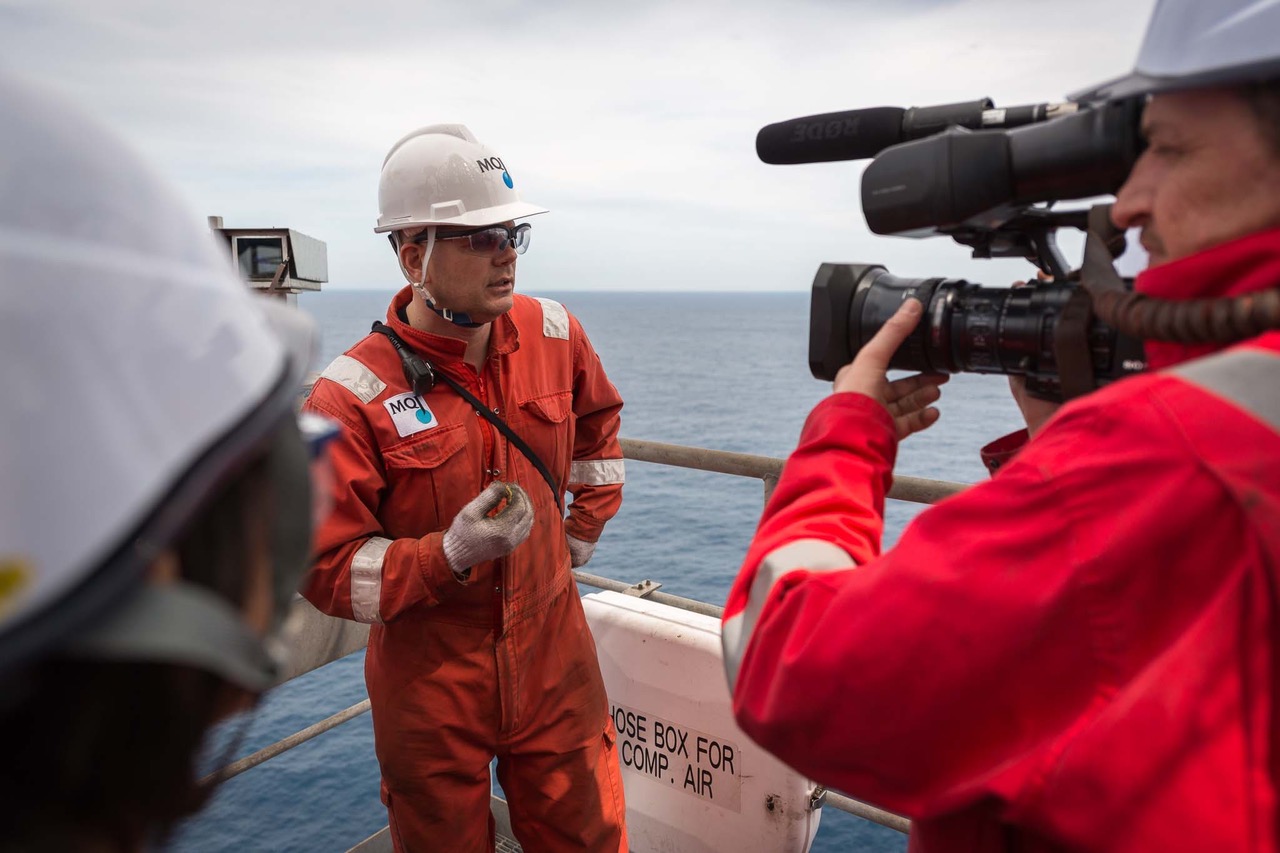

Dan interviewing a member of the Chikyu‘s crew at the top of the drilling derrick. Photos by Dick Peterse, courtesy of Dan Brinkhuis.
BMR: Before moving to outreach, let me ask you one more question related to life onboard. What are the differences for you, for your work, between being in the JR or on a Chikyu expedition?
DB: In principle they are the same, because everyone and everything is organized in shifts, as you have also experienced yourself. 12 hours up, 12 hours down. I was in 24-7 shift, especially on the JOIDES, where I was on my own. I had my own cabin, which was kind of nice because sometimes people call me in the middle of the night, “Hey, Dann, there’s something going on!”. One example, we were in the Arctic and it was 3 a.m. in the morning, I was sleeping and the phone rang in my cabin. It was the bridge, and they called me, “Dan, we are getting into some icy parts, some small icebergs. Don’t be alarmed, we actually try to hit those because we want to see if the ice string on the wall of the haul, how it’s helped. It might be interesting to come up to the bridge”. It was still a bit dark, but then I hear the bounces, so I got up, got my camera, and went over the bridge. And because it was dark, there was basically not so much to see. So, I took a few shots and said, “Captain, thank you. I think I’ve got it”. And the next day I had a look at it, and it was all out of focus. I was still kind of sleepy.
So, that’s what you get when you’re on your own. But, you know, that’s the nice thing about being on research vessels like this. Mainly, the operations are repetitive so if you miss it one day, you probably can shoot it the next day, tomorrow, because you have time. You got two months on the ship – in the case of the JOIDES at least – to do this. So, yeah, many, many anecdotes like this. It is actually pretty hard, working for outreach, because you are on your own. Sometimes the systems let you down and you want to communicate. There are all kinds of things you encounter, but you always find solutions. So, there’s no other real big difference between the atmosphere on both ships – because I sailed both – it’s roughly the same. Obviously, Chikyu is bigger and has different kind of tools and equipment, and is carrying more people. But the atmosphere, the process, is the same.
BMR: The relation with the people, with the crew, with everyone… works same.
DB: Yeah. Then, talking about video – because now we’re going to hit the sweet spot. All the outreach people are briefed to focus on the science, which is obviously why we are out there. But if we want to attract a larger audience, let’s say the science community, you have to have a different angle. You got to have a different story. Then, science becomes more of a background. But how interesting is to, let’s say, have a young PhD female from Japan working together with a French professor, a Brazilian EPM (Expedition Project Manager) combined with a Dutch co-chief?
Long story short, we got a lot of people, not only the science party that was in the IODP program from 28 countries, but also the crew, with their backgrounds and culture. Hence, my Star Trek kind of metaphor, “To boldly go where no drill bit has gone before”. That’s interesting, the cultural side, and how this group of people that don’t know each other, as you mentioned earlier, becomes one orchestra – hopefully, if everything turns right – to achieve their goal. That’s the magic, and that’s the story.
But it is very hard to convince the scientists that this is the angle. Again, comfort zone. “Please, report about science”. There’s nothing wrong with that. But maybe, on video, you should approach it a little bit different to get attention because as you mentioned, I thought about all the green books (note: the DSDP and ODP volumes) with almost 50 years of scientific knowledge, which is amazing, it was astonishing. But it’s not interesting for people. We, basically, would like to attract. So, we’ve been struggling in outreach in targeted audiences, in funding also, of course. Because, “Do we want to spend some money on science or on communication?”. Interesting discussion.
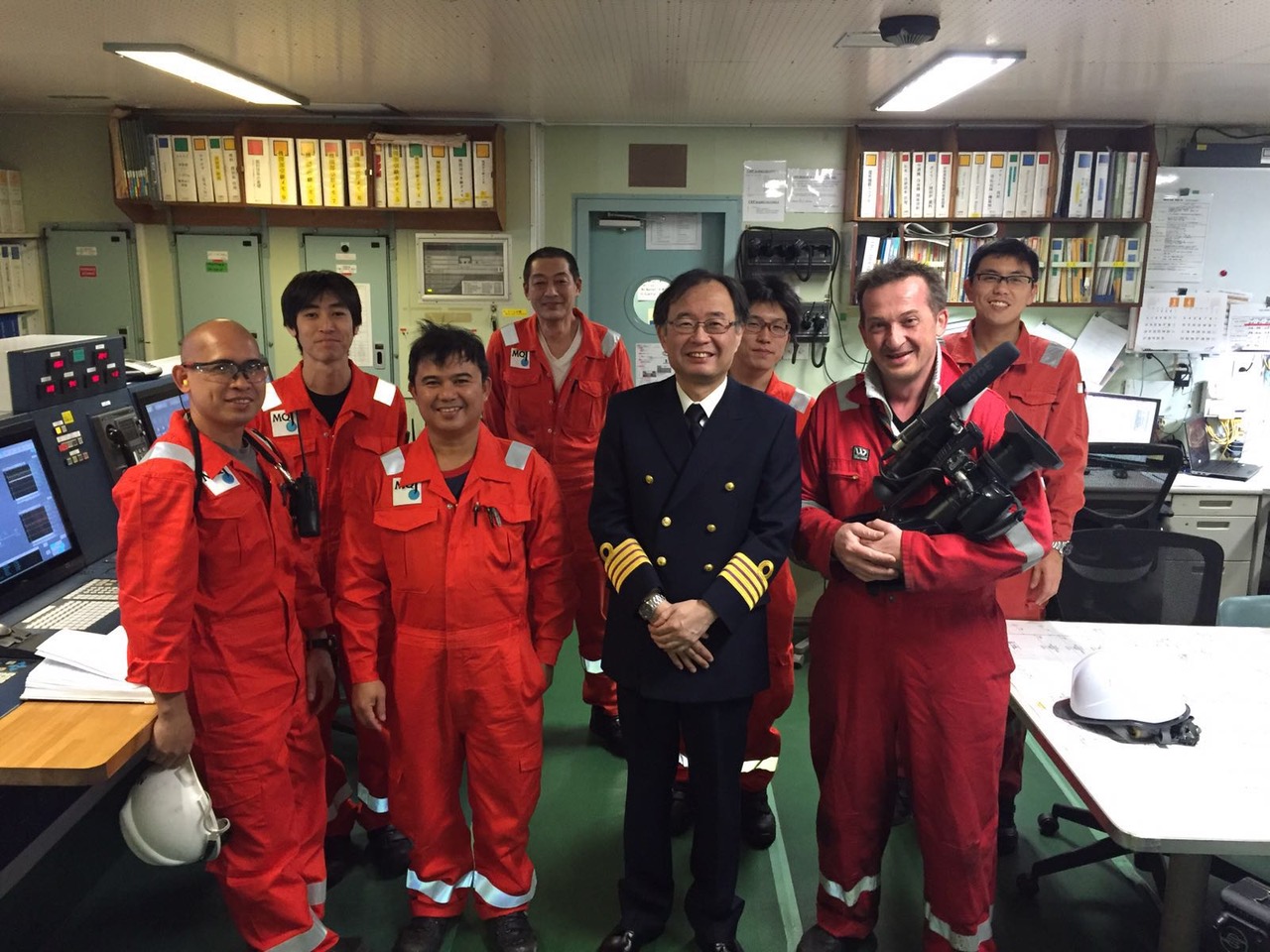
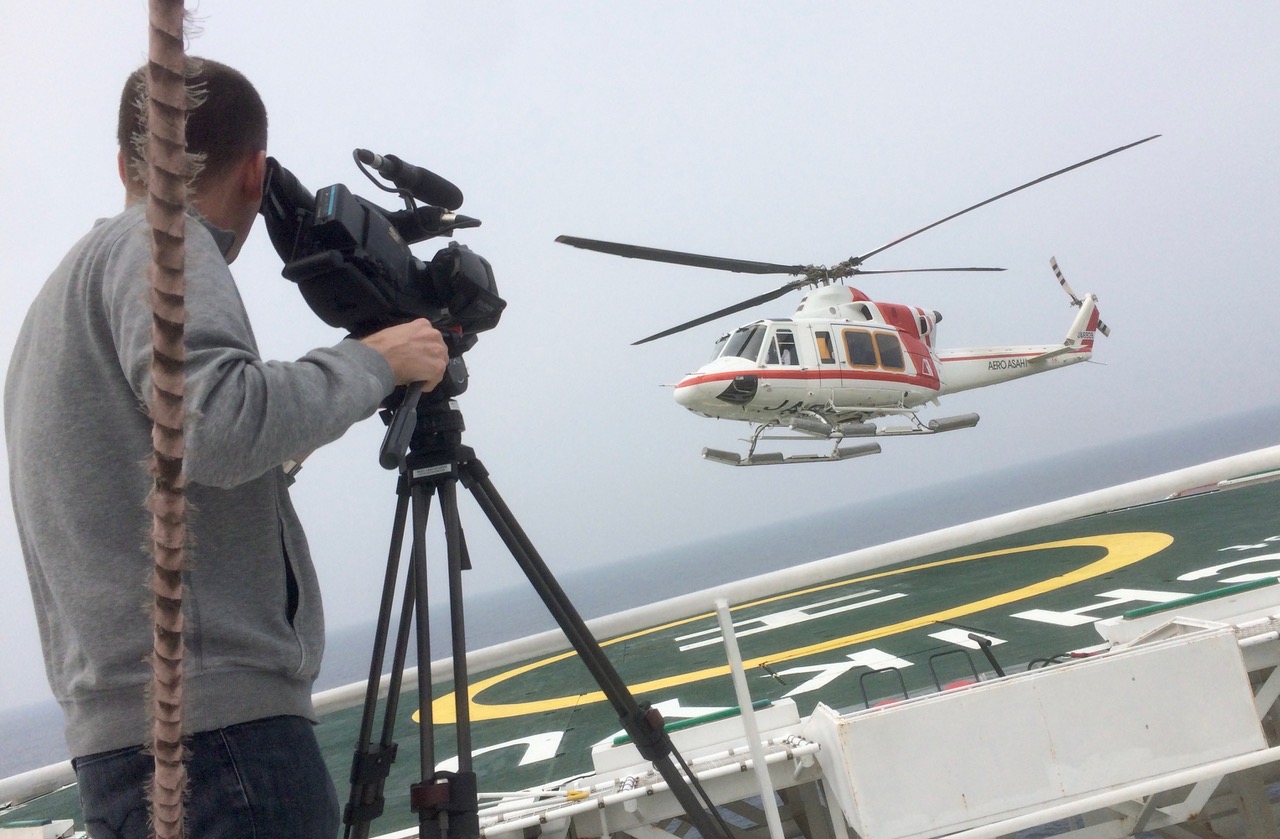

Dan working onbaord the Chikyu. Left, posing with the crew and the Capitain at the engine room. Right up, Science Media filming the helicopter landing. Right low, Dan sitting on the driller’s chair. Images courtesy of Dan Brinkhuis.
BMR: How have outreach activities evolved in these 20 years that you have been involved in IODP?
DB: As a third party, I’m fortunate that I have not joined every IODP outreach meeting because it’s very complex. You have multiple countries that basically also have their own outreach. So, to get combined projects run, there are few good examples where we really worked closely together, but it’s very hard to get all the noses in the right way. I don’t know if that’s the right answer. It’s hard. It’s very fragmented. Outreach is very fragmented. There are many channels. There are too many channels, to be honest. It’s not focused. Although there are fantastic things being made by a lot of outreach officers and creative people. There are painters, there are musicians, there are… Now we sail with Dorianne, she is an amazing photographer.
You get this group of very creative people that don’t know much about science and, when I talk to them, they all kind of have the same approach. And also we talk about that during our conversations at AGU, where we also meet. And, they also struggle with that. On the safe side, it’s always good to report about the science. So, we also have here Daily Science reports. And there’s nothing wrong with that, but it’s not something you should communicate, if you want to attract lots and lots of audience.
Another issue, and I think also Carl [Brenner] has mentioned that, there are limited budgets. So, on the one hand, you have all these countries that basically are free to go and to do, or to hire, or whatever they want. But in general there’s not much funding to invest, not only in creating outreach tools, but also in sending out the message. So, there’s a problem there, which in the 15 years I’ve been involved it has not been not fixed. It’s still there. The challenges are basically still there.
But what we did achieve this large group of people – the outreach people within ECORD, within JAMSTEC, and also within USSP… It is amazing, what we did and what we achieved in the past 10, 15, 20 years. And although we could say, “Well, we did not get the attention that, let’s say, Discovery Channel kind of media would have”, what we did was actually very effective and very good. We are only kind of limited in telling the story because we don’t have any money to really invest in, let’s say, promoting our stuff. That’s on the one hand, it is frustrating. And you could say, “could we have done better?” Yes. We could have been better. But, what we did with the means and the people, it’s impressive, actually.
I think that also the scientist themselves realized that outreach is becoming more and more important, that the younger generation of scientists are used to blogging, vlogging, etcetera. So, my hope for the future is actually pretty positive, because there is much more awareness of the importance and the relevance [of outreach].
Now, if it was up to me, there needs to be a structure a little bit more centralized. Look at it as a brand, like NASA – it’s a completely different organization. It’s got nothing to do with IODP. IODP is completely different organized. But the IODP logo, for instance, are you impressed by it? I think we should, hopefully in the future, come up with a more conceptual branding-orientated approach in outreach. That doesn’t mean that there are rigid guidelines, but we must basically try to make that, what we’re sending out is kind of uniform. And because IODP has no infrastructure, there is not like, let’s say, a head of outreach, or communication director, or whatever you call it. It’s everyone on their own.
Within those limits, what we did were amazing things; but there is not like a synergy of all these efforts. There is not an overarching, long-term, outreach mission. It’s basically year after a year. It’s also very expedition-oriented. And these are challenges for the future, to see if we can learn from all the good things we did, and integrate it in a much more efficient structure. Because the stories we all experience and share, they’re amazing.
One anecdote – I’ve been to Discovery Channel to talk about making a documentary on IODP. And they were completely not aware of IODP. I said, “well, it’s just been around for a couple of decades”. So I showed them some of our work and they were really blown away. This checks all the boxes, right? It’s adventure, it’s challenges, it’s technology, it’s science, it’s culture. It checks all the boxes. And they confirmed, actually, what I say – like climate change, we are kind of sick and tired of all that. But the stories… How about these people? That’s interesting, because they are being set in an environment within two months, and they have a joint mission. That process that was fascinating to me, was also fascinating to them. So it opened a kind of a door. But due to all kinds of restrictions and commercial budget they ask, this was a no-go.
So there are opportunities; but also because of a lack of, let’s say, investing in a budget in a long term, that you can actually invest in something like this… Because obviously it is taxpayers’ money being invested in science, and also in this tiny part of outreach. So, I’m actually looking forward to try to get this idea back on track. If we get our heads back together in a new program, IODP3, there will be another structure and then we can think, hopefully, in a joint mission and a joint way of communicating the amazing stuff that we do.

BMR: Actually you just answered the three questions I had in mind in a single response! Which is great. I was going to ask you about what are the challenges ahead, the things we have done right, and what do you expect for the future of scientific ocean drilling.
DB: Just an example. I just talked to Catherine (Ross) and she showed me her blog. And it was amazing! The language and the photography, it is very engaging and very easy to grasp the science. It is more like a personal log, basically, exploring Japan, and no one is aware of her. And it’s out there! That actually makes me feel happy, that also the scientists here share this passion. And, as I said, the young generation, they know how social media works. Let’s help them. Let’s try to come up with something, let’s organize something where we can kind of focus. And let’s let science also join outreach projects, integrate that a little bit further. But that’s like, you know, looking into a glass ball.
Currently, it’s still very uncertain what’s the direction of the program and who is going to be the members of that. But once that that settles, I hope that someone actually stands up and says, “Okay, now let’s think about a more fundamental way of communicating our science and not on expedition based, but let’s set a goal for ten years”. And, “How can we achieve whatever we want?”. That’s probably the best way to go.
BMR: What would that be, for you? I mean, from your perspective, what would be an achievable goal in terms of target population, specific groups…? Not thinking like, “Oh, we should be like NASA”, because that’s not achievable in ten years.
DB: No. NASA has a budget of millions and has a staff of hundreds of people. They are like a real brand. And if that’s the ambition, that’s not going to work. We have to be smart; we have to be lean and mean. But due to, basically, a lack of coordination, due to a lack of a joint strategy, it’s hard to address.
And I cannot answer that question, actually, because what is the ambition? What do you want? Do you want, let’s say, a million views on YouTube? Or do you want, let’s say, focus on attracting young scientists to become a climate or earth scientist? That’s achievable, if those are our goals. So, you have to determine what these goals are on the long term, and then find a structure and maybe even a format to get there.
And then, of course, it has to do with the structure of staff, of creative people but also scientists – not too many scientists, because you want to have a balance between, let’s say, narrative talents, and scientists who are really communicating. The way it works is that you try to find people who are comfortable around media; are comfortable on sharing their stories… Which obviously not everyone can or wants or do. And if you have a few of those and you have a creative team, and you have strategist – let me call it like that – then you can come up with some pretty good plan, depending on what the ambition targets is. If you will say, “Okay, we want to be on the Discovery Channel”, “we want to be like NASA”… That will take 20, 30 years, maybe? Or spectacular results… It’s a glass sphere.
I can imagine the people who are working within outreach community themselves, they must feel pretty double. On the one hand, what we did together in the last 15 years, at least in the part that I saw, is amazing. But I also understand their frustration because, on a higher level, of course it’s primarily science first – now I’m going to repeat myself. So, if you have the right team for a long term and clear targets, creative people, scientific people, and people who really understand media – I’m a media maker, not a strategist – but if you have the right people combined together, you can do amazing, amazing things with limited budget. That’s how I would like to approach the future. You get a lot of outside people in there who have been professionals in communication, maybe even marketing. Get those together, with the top young scientists, and the few people that are very good in their specific fields. That’s interesting. That will be my future for the program.
BMR: I’d be looking forward to see it.
DB: Me too. Wishful thinking.
BMR: By the way, I think you wanted to tell a story about the T-shirt you’re wearing.
DB: Oh, yeah! This shirt… This is kind of a weird story. As I told you, I started as a director of all kind of video productions, mainly for the industry and for commercial uses. I did that together with my partner, Bram [Verlaan], and we created the ZCENE Media Movie Company in the Netherlands. The first Expedition, 318, was commissioned by Ocean Leadership to our company. And now, just literally 15 years later – this shirt is 15 years old – my partner Bram is now with me on Chikyu, helping me out as my wingman. So, there are kind of sentimental reasons why I just wear this shirt. Although my company is now called Science Media, for me it’s kind of a round circle in my professional development. I’ve been basically doing for twenty years all kind of commercial work. And the last ten, fifteen years, dedicated to scientific ocean research. As I said, besides IODP I have also sailed for several other international institutions like Woods Hole [Oceanographic Institution] or the Royal NIOZ (Royal Netherlands Institute for Sea Research) in the Netherlands. So, I have my sea legs, and I’m personally enjoying this journey because it is a journey to build together. And now, with my former business partner being here… I could actually get him on the Chikyu as my wingman, which for me personally is a very satisfying moment. And I hope there will be many more expeditions.
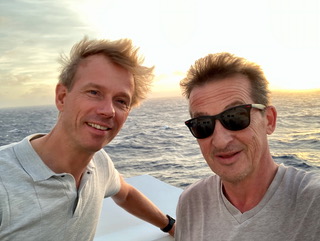
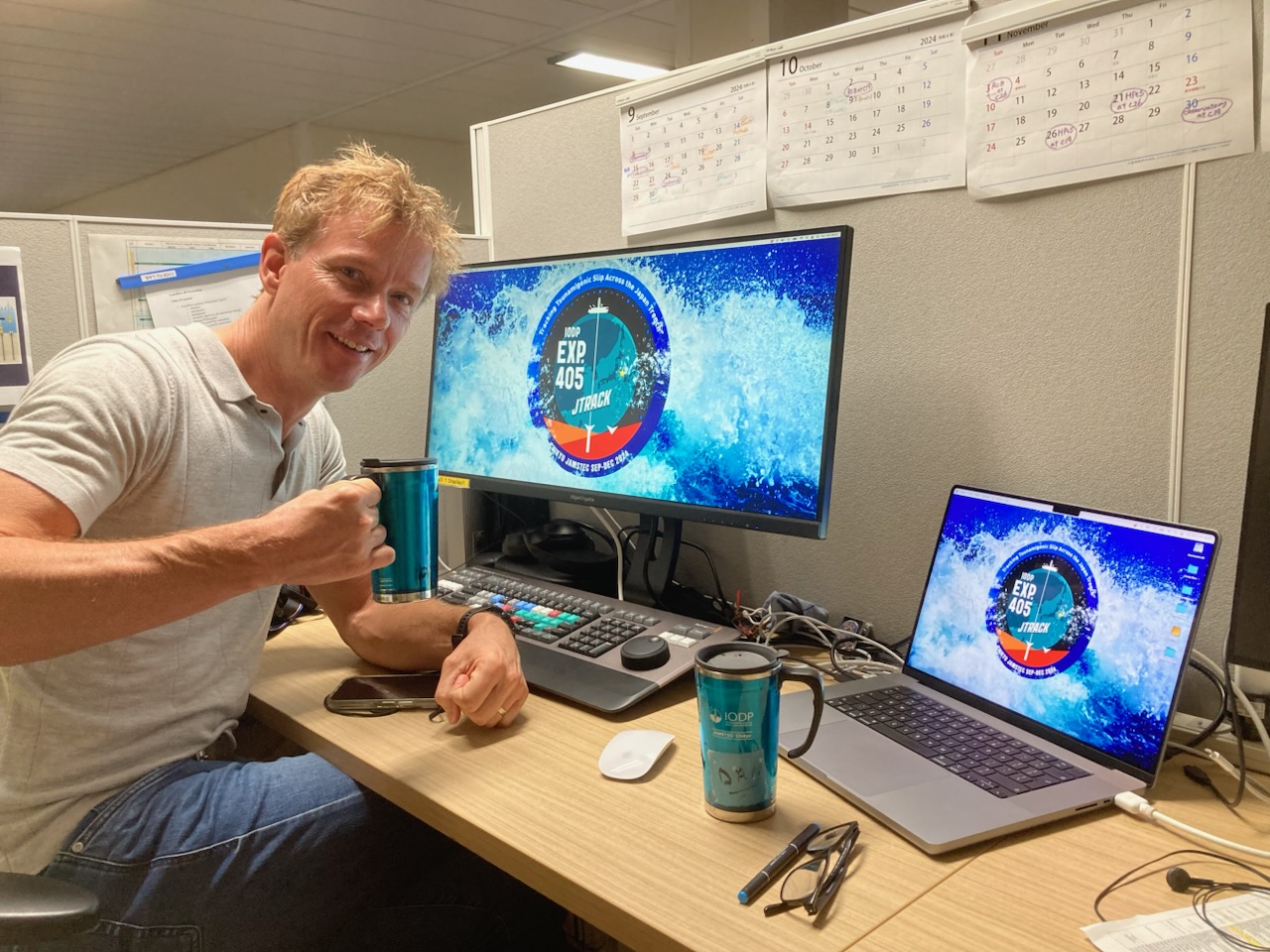
Dan and Bram Verlaam during IODP Expedition 405, onboard Chikyu. Courtesy of Dan Brinkhuis.
So, for me, this is kind of an amazing circle… I can explain a little bit more, because these are completely two worlds. Now I have invited Bram, welcomed him to the world of IODP, and now he is fascinated by it. So the magic that we talked about, it happens on the ship. This is, the ship is basically the tool that gets everything and everyone together. And, in storytelling, everything beyond that basically is not that interesting. Sure, the meetings and conferences, and… But the atmosphere on the ship – you see how people develop, how people interact, how people become even more secure about their work… That’s so fascinating, to be a part of that. And with my profession, filmmaking, to document that without being intrusive, being basically part of the team… That’s when the magic happens, when you are yourself part of that group, like this fly on the wall.
One of the other things is that it is also really appreciated. So, why am I doing this? Obviously not to become a millionaire, that’s for sure. But what happens, is that you build up a network. The scientists that work together here, now as young PhD researchers, they connect and bond, and probably will work together for many, many, many years or even decades. And that kind of bonding process, that has happened to me, as well. So, we make these videos and then I come back to the JOIDES or in this case to the Chikyu. On the Chikyu, all the drillers, “Hi, Dan! Are you back? Thank you for your videos!”. That almost makes you feel at home… The appreciation of what you’re doing, and the interactions, and the relationships you get, are one of the kind. I can truly say now that I have friends worldwide. That experience in my life at this age – I am 50-ish… 57, to be honest. I found that very enriching for my life, and I’m very happy and maybe even proud, to be a little part of this.
BMR: What have you learned, in these years inside ocean drilling? For your personal life, for your work…
DB: Maybe what I learned is probably this. You know, it’s not for all, doing this; but to see the world, explore these worlds, ask questions, answer questions, get an answer and, at the moment you got the answer, then two new questions, ten new questions arise… Personally, I found very, very satisfying to communicate that. Trying to make bridges between hardcore, complicated science and an interested public. To try to facilitate, try to make it easy, try to make it fun. That’s what I like. And that’s what I will always remember. Because it’s not scripted, what we do. You go on a ship, you bring your expertise, like the scientists, and you basically go with the flow. Most expeditions are very successful, including the whole integration of the science party with the crew, with the housekeepers, with everyone. Obviously, there are also some expeditions that were not that successful. But, in general, this is the way in which it’s a unique program. This is still the way we should go forwards, hopefully. Because there are many programs, there are many opportunities where scientists from different fields can meet and can talk, but the circumstances being together on the ship, in stormy weathers, and in whatever conditions… I learned from it, but I also enjoyed it.
I did not learn, let’s say, that much about hardcore science. Sure, I know the basics; but I learned how to help people, and supporting them, and finding ways to get them feel comfortable. I have meet interesting people; I have worked hard. That’s always on the ship, that that goes for everyone… Try to create some kind of synergy in what we do together, and maybe to be a little bit of an engine. I can give a little bit more speed and try to help scientists get their message out in an engaging and funny way – or maybe not-so-serious way. We have lots of fun, on the ship. There are lots of videos that are not on YouTube, which I think if they were, there would have been a lot of hits, to be honest. So, it’s the experience of basically meeting new people and getting the job done. And this is not easy. Ask the co-chiefs, how hard it is to become a director of this orchestra that you don’t know, right? And, that’s the fascinating part. And normally it works, and it’s very satisfying.
BMR: Well, thank you very much, Dan.
D: Thank you very much.

